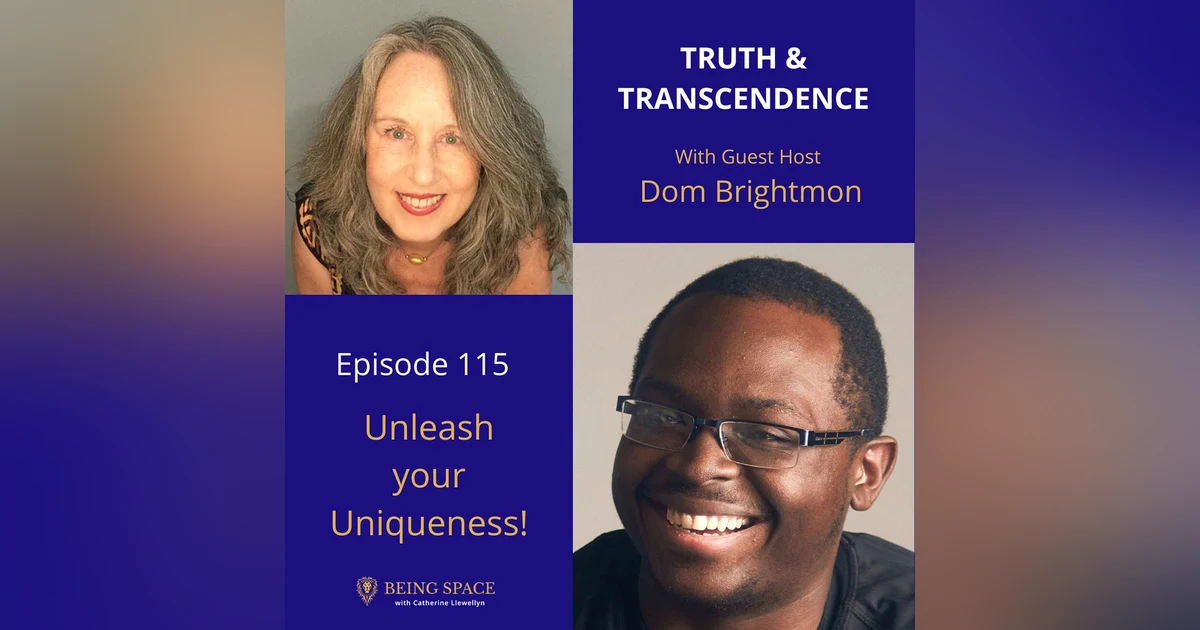
Ep 115: Dom Brightmon guest host ~ Unleash your Uniqueness!


 RSS Feed
 Dominique “Dom” Brightmon, DTM is a certified trainer with the Maxwell Leadership Team, bestselling author, and host of the Going North Podcast, a podcast committed to featuring authors from around the world to promote the power of the written word and inspire listeners to publish books of their own. His mantra is "Advance others to advance yourself".
I recently had the pleasure of joining Dom as a guest on his podcast. This was such a great conversation, I decided to share it with Truth & Transcendence listeners.
Dom and I talk about my books, embracing uniqueness, my journey to discovering humanistic psychology, and more:
~ What is humanistic psychology and how it enhances my work as a facilitator and mentor
~ How I overcame my initial belief that I couldn't write
~ The importance of thinking for ourselves and how it can lead to better outcomes
~ Three major lessons learned from starting and running Truth & Transcendence
Find the Going North podcast here, and on all the usual apps:
https://www.goingnorthpodcast.com/
The music in Dom's podcast is titled "Money Trees" by the magnanimous chill-hop master, Marcus D (@marcusd). Be sure to visit his site and support his craft.
https://marcusd.net/
=========================
More about Catherine / Being Space / Expansive Coaching
https://beingspace.world
✦ Explore Expansive Coaching
If something in your life is beginning to open — or there is a sense of moving toward deeper alignment — you’re warmly invited into this work.
This is a space for reflection, unfolding, and spacious conversation.
A simple way to begin:
🔹 Taste session (20–30 mins) — experience the work directly
https://go.oncehub.com/TasteOfExpansiveCoaching
🔹 Q&A call (15 mins) — ask questions and sense whether it feels aligned for you
https://go.oncehub.com/ExpansiveCoachingQA
🤝 Join our Being Space Community
✦ Podcast: https://truthandtranscendence.com
✦ Website: https://beingspace.world
✦ YouTube: / https://www.youtube.com/@BEINGSPACEcatherinellewellyn
✦ Instagram: / https://www.instagram.com/beingspace.world/
✦ Facebook: / https://www.facebook.com/BeingSpaceWorld
✦ TikTok: / https://www.tiktok.com/@beingspace.world
Support the podcast: https://truthandtranscendence.com/donate
00:02 - Unleashing Your Uniqueness and Happiness
08:23 - Discovering Uniqueness and Humanistic Psychology
22:14 - The Type a Wrangler
29:12 - Writing Ebooks and Overcoming Blocks
44:46 - Lessons Learned From Starting a Podcast
51:00 - Finding Your Own Questions and Following
56:02 - Promoting the Going North Podcast
Truth and Transcendence, brought to you by being Space with Catherine Llewellyn. Truth and Transcendence, episode 115, with guest host Dominique Brightman. I was on Dom's podcast, the Going North podcast, recently and it was such a great episode that Dom gave me the MP3 and said if I wanted to cover it onto my own podcast, truth and Transcendence, I'd be very welcome to do that, and it is such a good conversation, very entertaining. We are talking about releasing your uniqueness and I've included all of Dom's music and promotional aspects because I think it's all really good. So I hope you enjoy this brilliant episode with Dom Brightman, guest host. The trouble is that Taipei people often find if they go to a coach or a facilitator, that person tries to make them soft, tries to make them bring up their feminine side, or tries to make them more flexible, more this, more that. In other words, tries to kind of neutralize them, whereas I'm not interested in neutralizing anybody, I'm interested in okay, you're magnificent. Now how could you use that more as it is?
Speaker 2You are now listening to the podcast where authors inspire listeners to become authors the Going North podcast. I'm your host, certified self-leadership trainer, best-selling author and book enthusiast, dom Brightman, and you're going to be listening to a different author that will inspire you to join the business of immortality known as authorship. Now let the fun begin. Today's episode is sponsored by the Going North podcastcom shop. Head over to that wonderful website to pick up some merchandise. We got shirts, hoodies, mugs, t-shirts, flags, notebooks, journals just about almost everything under the sun, even stickers and buttons, indeed, for your lanyards and for your decorations as well. And we got multiple designs, advanced others to advance yourself. We got the Going North podcastcom logo, as well as outreach, your competition to out lead your competition. We even got bags too. So check out the wonderful podcast merch shop and be able to look out for sales. They got wonderful 35% off sales spread out throughout every single month, so that way you can save even more money, so you can get more bang for your book, so you can bang out your goals through the inspiration you're going to get. Today on this podcast Check it out like a library book, my friends. And today on the highlight, real builder for authors, known as the Going North podcast.
Speaker 2We got another super special, awesome human for today courtesy of podmatchcom, the wonderful site where podcast guests get to connect with podcast hosts and if they're cool they're freaking in. And today's guest is cooler than 10 cucumbers. That's right indeed. Why be cool than one or two, be cool than 10, a whole decade of cucumbers? Because today's guest in particular, she hails for whales, baby. That's right indeed. And we're not talking about the humpback, but we're talking about the whales in the UK.
Speaker 2Because she's a fellow bookcaster y'all. That's right indeed. A fellow book cast, because not only she writes books, she also is a podcast host as well. So she knows how to rock both sides of the microphone and to make it even better, and not butter. She's a transformation catalyst, humanistic psychologist, a type A wrangler, intuitive healer, conscious dancer, executive mentor, organizational transformation strategist and a meow lover. So all the cats love this lovely lady because our first name starts with C, because she's got all the vitamins for you to help you amp up your life, and the L's for all the lessons you're going to learn today. So let's give it up for Miss C? L herself, the one and only. Catherine Llewellyn. How you?
Speaker 1doing today? Catherine, I am doing great. Delmit, fantastic to be here, thank you.
Speaker 2Woohoo, that's right. Indeed, it's fantastic to have you here too. I'm like, yeah, when I first did the sound test, when you did your podcast bitch, I'm like, oh, she has one of them, super special, awesome UK accents. Sorry, she's in.
Speaker 2It's just pure luck, I promise you. That's right indeed. I'm like yep, americans always suckers for accents, especially great ones like yours. Indeed, just puts people easy. Probably talk about basket weaving and cupcakes for five hours Not enjoyed. That's right indeed. That's right indeed. But hey, it ain't about cupcakes and basket weaving, it's about the superstar Catherine herself. So, my goodness, as you know, with all bios not allowed to be 85.95 years long, I probably covered 95 minutes of what led you to where you are today. So it's your first time on the show. Mind giving listeners a bit of how you became the Catherine that you are today.
Speaker 1Well, I started in a really kind of unusual way because my parents were kind of runaways from their backgrounds. They said, no, I'm not going to stick with what everyone thinks I ought to be doing. I'm going to do something completely different. And so, of course, they were brought us up to think for ourselves and to be adventurous and creative and to not try and fit in to be an individual. So that meant I went through life really connected to that, quite adventurous, sometimes stupidly so, and I learned a lot. I had a lot of interesting experiences.
Speaker 1When I reached the age of 60, someone said to me how do you feel? And I said surprised that I haven't actually killed myself by now by doing some of the stupid things I've done in life. I've always been really, really interested in what is it that makes us happy? And I've also always been very interested in why do so many of us put so much energy into talking nonsense and pretending stuff we don't even believe in? And so I've always been really interested in trying to solve some of those mysteries for myself and help other people to do that as well.
Speaker 2So I'm talking about, indeed, I'm talking about, indeed, so doing a bunch of crazy stuff. You see, actually out of curiosity, have you ever heard of that show? It was like an early 2000s called Jackass.
Speaker 1I have heard of it. I've never done anything like that. I'm afraid I'm not brave enough for that.
Speaker 2Okay, because when you say it's brave enough for a surprise, you're still alive. At six down like wait a second. What the hell was she doing?
Speaker 1You know. I mean it's sort of things where your friends are going oh god, someone's got to talk to Catherine. She's just doing stuff that is just mad, it's pointless, she's never going to settle down, she's never going to find security, she's never going to make any money, she's never going to be normal, she's never going to fit in, that kind of thing. So no, I'm not really normal, I don't really fit in, but I'm very happy and I have a really rich life. So I've kind of followed more of that path rather than the path of how do I get comfortable, how do I get secure, how do I get a good retirement nest egg I think you call it a 401k over there, all those things that were encouraged to sort of go after. You know how do you find a good husband if you're a woman? You know how do you? All that stuff I've always been more interested in how do I follow what's interesting to me and exciting and where I can learn something and where it's going to be different, so kind of like that.
Speaker 2I'm okay. I was about to say what was she doing? Was she ballroom dancing with an invisible partner on the plane before she jumped out of it, like what the heck was she doing? What part of the research did I not get in the past? She was like, okay, but hey, it's all good, ain't nothing wrong with being different Cause? Hey, it'd be boring if everybody was just gray and neutral and bald for no reason and we all believe the same things. Yeah, walk the same way. It's like oh yes, yes, we are neutral, that's right. Indeed, we are all the same, no differences whatsoever at all. So I'd led you to discover your uniqueness.
Speaker 1Wow. Well, I was kind of told I was unique right from the beginning. So I always knew it and I just knew everyone was unique right from the beginning. And in fact at school the teachers used to say to me why do you always have to try to be different? They literally didn't understand. I was in front of them, this child of eight or nine years old, and they couldn't understand why I wanted to be different from everybody else. Why are you always trying to be different? And I would say, well, why would I want to be the same as everybody else? And all through my childhood, all these teachers and a lot of the adults around just found me completely impossible to understand. They couldn't understand why I didn't want to try and be the same as everybody else, to just fit in and look the same as everybody else. They just couldn't understand. I've never understood that. I've never understood the attitude my whole life. It makes no sense to me. Why would we all want to try to be the same?
Speaker 1But I think when you ask that question, how did you find your uniqueness? I think at different points in my life I've asked myself the question what is it that I bring that only I can bring. What is it that only I can bring? And I did this process once, when I first set myself up as an independent facilitator and coach and so forth. I hired this woman she was a psychologist and she had me fill in this long questionnaire, and this questionnaire analyzed my preferred ways of thinking, which I thought was such a cool idea how do I like to think? And it came up with this sort of mixture of colors and shapes and things, which was my profile. And this profile had a name and the name was Inspiring Changer. So this meant somebody who helps bring about change through inspiration and imagination and creativity, rather than someone who brings about change through planning and getting organized and moving furniture from one place to the other kind of thing. So both are really important. But I was the inspiring changer and I thought that's really amazing because that tells me something about my style and something about the way I work with people.
Speaker 1So at the time I did this, I was in my I think I just turned 40, 40 years old and I was just embarking on this whole new way of doing my work as an independent business owner, and so that really led me for the next 20 years into working with people in that kind of very intuitive, imaginative way, which was kind of unique. The way I did it was kind of unique. And then there were other people who were much better at other styles of coaching and working with people and if someone wanted that I'd say, well, go and work with that person. Or if they wanted what I had to bring, they could come and work with me. So that's one example. And I've had other examples at different times when I've sort of said to myself, what uniquely can I contribute? And the answer has always been different. And that was a very significant one at that point, when I was 40 years old.
Speaker 2There we go, there we go indeed. So, my goodness, my goodness. So with all that wonderful work, it led you to the wonderful world of doing humanistic psychology. So I guess, with all of your wonderful interests, like, how did you settle on that of all things, even though you probably do 20 other things in addition to that?
Speaker 1Well, it's kind of a funny story because when I found out about humanistic psychology, I found out I'd already been doing it for I don't know 16 years before I found out what it was called. And I think this happens to people more often than we think, where they sort of intuitively start doing something a certain way and then they go on a course and they find out what it's called. So I did a master's degree same sort of time as I did. The piece of psychology work with the woman ran about when I was 40 years old and I'd already been doing coaching and facilitation work for 16 years at this point if that may be more than 16 years and I'd kind of made it up as I went along and I'd sort of picked up stuff from other people and I'd been on workshops you know when you learn about yourself and I'd kind of developed my own approach. Then I went on this master's degree and they said, right, this is humanistic psychology, this is what it's about. And I thought, oh my God, this is what I've been doing all this time and what it is really.
Speaker 1And of course now humanistic psychology was first developed about 50 years ago and at that time it was very new, but now it's everywhere. I mean everybody's doing it, even if they don't know what it's called. So it's like the opposite of psychoanalysis. So psychoanalysis is where you lie on a couch and you think about all the awful things that happen to you as a child and everything about your parents. That was not quite right. And you talk about that for months on end and you eventually come around to who are you now and what's going on With humanistic psychology, you start now in the present and you say, right, what's going on now?
Speaker 1And you focus on what's going on now. That's great. And you focus on what's already great about that human being or about yourself and you say, what if I'm already absolutely fine as I am, do I want to grow? What is it about me? That's amazing and awesome already. How can I even get more out of that and enjoy that even more and contribute that even more and be even more fulfilled? So it's a very, very positive, growth-oriented, appreciative, respectful.
Speaker 1In humanistic psychology you never tell people what they should be learning. You never tell them how to do it. You ask them what they want to, how they want to grow, and you ask them how they'd like you to help them. So they are like the client they're not the patient, they're the client. And so it's a very respectful, very loving, very intuitive way of working and that's what I'd been doing. I won't say I was perfect at it, but that was my basic approach. And then I did this master's degree and found out what it was really called and learned a lot more at that point, which, of course, then really strengthened what I was doing. So that was when I was 40, which now I'm in my mid-60s, so that's like 26 years ago. And then I've really pursued it since then and learned even more about it. So, yeah, thank you for that question. It's one of my favorite things humanistic psychology.
Speaker 2Oh, there we go. Indeed, has there been a major lesson that transforms your wonderful experience as a psychologist? At least one of your clots may have taught you.
Speaker 1Yeah, do you know one thing? That was a big, big lesson for me and I don't talk about this very often because at the time it was very difficult, very painful. Before this event that I'm going to talk to you about, because of this really positive approach, I had this idea that I could help anybody to transcend, be the best person they could be, and that if I just loved that person enough, respected them enough, spent time with them enough, that was going to happen. And then one day I know naive, right, but then one day, years later, I got into a relationship with the wrong guy very much the wrong guy. I was obviously in a weak place at the time, but I made a mistake of getting involved with this wrong guy and he gave all the signals of being really interested in what I was into and everything and wanting to be an amazing person, all of which was not true. And because I had this belief that I could actually help anyone be the most they can be, I stayed involved with this person much longer than I should have done, because I kept thinking, oh, just around the corner he's going to really turn around and show up as the person I imagine he could be.
Speaker 1Of course it never happened and I eventually extricated myself from that, but that gave me a really strong lesson in terms of really understanding. It's absolutely not up to me who is going to learn from me, who is going to flourish around me, and I need to be a bit discerning about who I hang out with and where I put my energy. But equally, I need to really lean back a little bit and just let people come towards me. And if someone comes towards me and they really want to grow around me or show up with me or meet me or engage with me, just watch them and see if they walk that talk and if they don't let them go. And that was a powerful, powerful, strong, strong lesson for me and I'm actually very grateful to that person now for that.
Speaker 1I wasn't grateful for it at the time. At the time I was really upset, but now I have much gratitude for that very, very strong piece of learning. And I've had a lot of people talk to me about really big pieces of learning they've had from a situation that was basically a disaster and then they've got a massive piece of learning from it and they've kind of gone whoop up a level or up a couple of levels in terms of their understanding of themselves and of life and their place in life. It's like we all have our own place I can't have your place, you can't have my place, finding our own place and our own edges, and what we're capable of and what we're not capable of, and when we need to let go and when we need to hang on. For me, that's a lifelong lesson, but that was like for me, a good example of a strong piece of learning. I've got lots more if you've got hours and hours and hours, but that was the one that came to mind when you asked me the question.
Speaker 2Ah, I got you. I got you indeed. And they didn't start off as a client first, did they?
Speaker 1No, no, no, no, no, no. But they were like Catherine, you're amazing, we're in this relationship. I feel like I could learn so much from you. God, you're into this staff. It's really amazing. They flattered me and it just totally I bought the flattery but actually no, no.
Speaker 1I keep a very clear line between clients and personal relationships because if I have a personal relationship with them, I know too much about them for one thing, and also I'm attached. I've got an ego agenda in relationship to that person because I'm personally involved. So my clients, I do not have that ego agenda because I'm not personally involved with them. And in fact, if someone I know very, very well asks to work with me as a client, I will 98% of the time I'll say actually no, I don't think it's a good idea. But I will have a chat with you to help you work out exactly what you're looking for and I will refer you to people I know. But otherwise I can't serve you properly. If I've got an agenda in relationship to you, if I care about you too much or if the nature of the relationship is something that's really important to me and I don't want to risk losing it, et cetera, et cetera, no, I won't, so I keep that as a boundary.
Speaker 2Yep, good deal indeed. So I guess, learning to keep that boundary dealing with the classical, I can change them It'll all work out.
Speaker 1It's really embarrassing now.
Speaker 2That's a deal. So did those past experiences lead you to being a Type A personality wrangler?
Speaker 1Well, actually funny should say that, because this person was actually a Type A, and this is only just now. I've just realized that I haven't made that connection before. Yeah, so the Type as, they're magnificent. Type as are magnificent, they are very. They're usually very strong, very sharp, very powerful individuals and we need them in the world.
Speaker 1The trouble is that Type A people often find if they go to a coach or a facilitator, that person tries to make them soft, tries to make them bring up their feminine side or tries to make them more flexible, more this, more that. In other words, tries to kind of neutralize them, whereas I'm not interested in neutralizing anybody, I'm interested in okay, you're magnificent, now how could you use that more as it is, rather than how do you suppress it and tone it down? Because Type A people can be quite challenging to be around. They can be quite difficult to be involved with for people. So what that means, they need to develop some skills around that.
Speaker 1But it's very important they don't try to be a Type I don't know, b, c, e, whatever it is if they are a Type A, because they're just going to neuter themselves and that's no good. So I actually like those people, I rate them, I respect them, I'm not frightened of them, I can meet them and I can actually work with them in the way that they'd like to be worked with, as opposed to trying to kind of make them fit in with everybody else better. I say no, don't try and fit in with everybody else. Be amazing as you are and just learn more about that. Now you can express it and use it in your life. So yeah, that's where the Type A Wrangler came from.
Speaker 2So how does this help out in business? Do you help out those organizations who may have those wonderful type A folks who may show their fangs a little too much and try to strangle everybody like a bull constrictor Like where does that fall into place?
Speaker 1Yeah, I've done quite a lot of that actually working with these people and usually actually, it's that person that reaches out to me, because they're quite smart, you know, they're not stupid, and so sometimes they reach out to me and say, look, catherine, I want to still be me and I want to still lead strongly. I think I need to lead strongly and people need a strong leader. But I want to kind of understand these other people better, these people who are not the type A. I want to sort of understand them better so I can relate to them better and lead them better and also encourage them to think for themselves and to sometimes say no to me, because a lot of these people would like to be said no to more often by people, but because people are frightened of them, no one ever says no to them, which means they're stuck in this kind of a bubble of everyone saying yes, and it's horrible in that bubble. It's an horrible place to be. So they want to get rid of that bubble and they want people to be able to come up to them and say, look, that thing you just talked about doing, I don't think it's a really good idea and this is why. And so they want to be a bit more, they want to be approachable, and how do they do that? So it's very subtle.
Speaker 1Actually working with those kind of people, because you can't go straight into right, is a technique to do it differently. You have to instead kind of help them examine inside themselves a bit more and find the different parts of themselves that they're going to bring into play, so they're not just bringing one aspect of themselves into play, that they're bringing the other aspects in. Sometimes they put aspects that they show at home with their family that they don't show in the business, and sometimes bringing those aspects in is a really good idea to do and sometimes having a bit of help on how to do that, because that can feel a bit sort of counter cultural to them, a bit kind of scary to do that. So sometimes they need somebody to kind of talk to about that, maybe do a few like dry runs about it, and I've even had people ask me to come in and say, okay, catherine, will you come in and do a day with me and my deputy CEO?
Speaker 1So if it's a CEO, will you come in and do a day just with me and my deputy CEO and just help us understand each other better and help us understand how we can work together better and help us really. And they're both a bit nervous at the beginning of the day. They both want to do it, they both really respect the other person, they like the other person, but they're a little bit hesitant about getting into the feeling side of it a little bit maybe. And I just kind of hold that and facilitate that and help them get to a place where they're saying things like oh so you're saying that when I do this and this, you actually think it's great. Yeah, I do, I think it's great. I never knew that.
Speaker 1I didn't know. That it's really good to know. So one of that thing that you did then I just want you to know. When you do that, I find it very confusing Because I'm not quite sure where you're coming from. Oh, I didn't know that, okay, so I mean this oh right, well, that makes sense. These things happen in a moment.
Speaker 1But if you like, have the space for it, you set aside the space and so, with Type A, that works very well giving it the space and not trying to be too prescriptive and not trying to tell them how they need to be, because they don't need that. But sometimes they need a bit of a space with somebody who is supportive and respectful, but not trying to push them around. But we'll give feedback if it's needed. I will give feedback if it's needed. So, yeah, that can help businesses quite a lot when their leaders do that kind of work, because it makes it easy for them to kind of pass down, line their vision and activate their people. So their people get a bit more lively, a bit more imaginative, a bit more creative, a bit more thinking freely.
Speaker 2But, like I used to activate people because it's like they're like little folks who are still asleep, it's like they're in the bed or the kind of like robots, but not a robot or like AI. You press the buttons like, oh, they're animated, they're awake. Now they are finally realized the power button's been turned on. They can now go into the wild. They now have their power.
Speaker 1Well, it's like that, isn't it? When we wake up, we suddenly discover oh my God, I'm alive.
Writing Ebooks and Overcoming Blocks
Speaker 2That's right Indeed. That's right Indeed. Well, speaking of being alive, you joined the business of immortality by putting some work out there, throw your books. So I'd like you to become our writer and finally press the publish button.
Speaker 1Well, I had a marketing coach who told me you've got to write ebooks, you've got to write ebooks. I said I can't write, I can't write. I can't write because when I was at school I was told you can't write, your writing is terrible, you can't. And I believed it. So decades later, I still believed it. He said no, you've got to do it, you've got to do it.
Speaker 1And I was paying him a lot of money at the time. I thought I better follow his instructions, otherwise how am I going to get any value? So I did some work with at the time I had a practitioner supervisor who's like I'm not regulated, so I don't have to have a supervisor, but I decided to have one. So I chose this guy who was actually he was a writer and also a very powerful humanistic facilitator and about 15, 20 years older than me, so he was further ahead in on the path. I was already working with him. I'd been working with him for years and I said look, I want to do some writing. I've got a block, I can't get through it. So we did some sessions and through these sessions I started to write and at the time I would not long got very closely involved with a thing called five rhythms dance. Have you heard of that?
Speaker 2Yeah, no.
Speaker 1Okay.
Speaker 1So it's like freestyle dance, where you go into all kind of spaces in the dance and you kind of have a wonderful time and you work through your stuff, whatever you want to do. So it's like quite a powerful, conscious, movement-based practice and I was really into this. Now, in five rhythms, dance. The first two rhythms are called blowing and staccato. And flowing is all about going with the flow, being receptive, everything kind of being continuous and flowing and beautiful and like that. Staccato is all about being really clear, very specific, making decisions, crisp movements, shapes, all that kind of thing. And then the other rhythms of three other rhythms I'm not going to go into, but I've been dancing all these five rhythms for a couple of years by this time and he showed me that the first two rhythms were really really relevant when it comes to writing.
Speaker 1Okay. So the first one, flowing, was where you just sit down and you're just spewing out words. You're just writing words. You might be voice recording it to transcribe later. You might be doing it by hand or on the computer. You're just pouring out words and words, and words, and words and words and just flowing with it, with no idea about what the thing is going to look like in the end? No censoring, no editing, no stopping to try and think of a good way of saying it, you're just absolutely just pouring it out of you and you don't care if it's any good or not, and you just do that and then you leave it. You come back a couple of days and then you go into staccato, where you start reading it, analysing it, chopping it up, editing it, cutting bits out, adding bits. It's a completely different headspace and my problem before that was I was trying to do the two things at the same time and you can't do the two things at once. It's two different vibes altogether. So if you try and do the two things at once, you just drive yourself insane.
Speaker 1Now I do know an exception to this. I've got a very close friend now who's been a writer for decades. He can just sit down and write a book just in one go without doing what I'm talking about. But he's a very, very, very experienced, very talented writer and, frankly, he's not normal. This guy's not normal. The stuff he can write that's just beautiful, just out of nowhere, is phenomenal. But he's been doing it a very, very, very long time. For me, I have to do the flowing and then the staccato, and sometimes I'll go back and do the flowing again, do the staccato again, but it means I rewrite, I rewrite, I rewrite, I rewrite, I rewrite multiple times and I just let go of it being perfect until one day bang, that's it, I'm done. It's not perfect, but it's good enough that somebody could get something out of it. It's more than just sitting and watching TV. That was kind of what happened.
Speaker 1And then my first e-book I wrote was round about the time of the crash, 2007, 2008. One of the complaints a lot of my clients had was this thing of, let's say, you're a chief exec and you're saying why don't the board think for themselves? Why will they not think for themselves? Why are they always looking to me to think for them? And I saw this article in the Times about Lehman Brothers. I don't know if you remember Lehman Brothers going down was the first thing that happened and in this article it said that Lehman Brothers went down because the board was weak and the board did not control the chief exec and the board did not think for themselves, and that's why they went down. This article said that. I'm sure it's not the only reason. So I wrote this e-book and I put that quote in there at the beginning and I said, right, this e-book is about why don't the board think for themselves and what to do about it. I pulled together all this information from all my clients and all everyone I'd worked with and I analyzed it down to all the reasons why the board doesn't think for itself and all the things that the chief exec can do to correct that. So that was my first e-book, very short e-book.
Speaker 1The second e-book I did just for fun, because with this dance thing I was doing, I then went and trained as the dance facilitator. I kept meeting all these people and saying, hey, come along, come along, come along, come along. And all these people would say I can't dance, I can't dance, I can't dance, I can't dance, I can't dance. So I thought, oh, I'm going to do an e-book called why People Think they Can't Dance and how they Probably Really Can, because every single person who I've seen thought they can't dance. When they come on my dance floor they can dance. It doesn't take long if they forget trying to look a certain way. So I came up with, I think, 30 different reasons why people think they can't dance, like 24 different reasons why they probably really can.
Speaker 1And then I found this illustrator. He illustrated it all the way through with all these incredible images and that was just a although I say it myself, that was a really good piece of work, because I gave it to my brother and he started reading it. He got halfway through and he rang me up and said, catherine, this e-book isn't really about dance, is it? This is really about personal growth. And I said yeah. And he said yeah, but I'm in it now. I can't get out. I've got to finish it now. I said that's exactly right, got him. And then the third one I did. All these three are on Amazon.
Speaker 1The third one I did was a much longer one, because I reached a point where I'd been doing this corporate coaching for a long time, and something that we coaches always did was we kept a lot of secrets about how we were doing what we were doing and how we learned to do it and why we were doing it. And I thought, okay, I want to let go of this corporate stuff and keep coaching, but in a different way. So I want to give away all these secrets now. So I wrote an e-book where I put all the secrets in the e-book and it's called what is humanistic coaching and why do we care? And that's on Amazon as well, and so that's got all kinds of sections in it about why people choose coaching, what kind of coach they need, what are the different kinds of coaching, how does it work. How does a humanistic coach become one? It's a very, very, very detailed piece and basically I just downloaded everything I knew about that into that e-book. So those are the ones that are published on Amazon, but I've got a couple that are not published.
Speaker 1During the lockdowns over here in the UK and I'd already moved to Wales by then and in Wales it was even worse than it was in England and I say worse, I mean very strict, and I thought this is a really interesting psychological phenomenon right here, because everyone's responding differently to this and everyone's having all kinds of trauma. And then all kinds of people are having amazing wake-ups and people are pivoting and zigging and zagging and all kinds of stuff is going on. And I thought how is it that some people are really doing well with all this going on and some people are really doing very, very badly? What's the difference? And I basically just talked to thousands of people during that two-year period to find out what were they thinking, what were they feeling, what were they doing. And in the end I thought right, I'm going to write an e-book about this.
Speaker 1And I wrote this e-book and the first version of it I sent to a very good friend and they rang me up and said okay, I hope you feel better now you've written that. And I said what do you mean? And they said well, it's a really good download of everything you're thinking and feeling and everything you observed, but it's absolutely unpublishable. It's a complete bloody rant. It's an absolute rant. It's really opinionated. And they said look, I agree with everything you said, but you can't publish that. It's nonsense. A lot of it's right, but you can't publish that. It's not going to help them, right? But I hope you feel better. Yeah, I did feel better until I had this phone call, but I saw that this person was completely right.
Speaker 1I scrapped it and started again and I didn't know what I was going to find. I didn't know what the answer was going to be. So as I went through analyzing all this stuff, I eventually found that the people who did the best out of the whole thing were the people who think for themselves, whether they're rich, poor, black and white, english, american, whatever. The ones who think for themselves seems to be the ones who did the best out of it, because they did their own research, they made their own choices, they had conversations with the people they love, they had conversations with their families. They decided what they were going to do, they made sensible decisions and choices and they came through it much better than the people who just looked around for who was going to tell them what to think or who was going to tell them what to do. Those people actually came out of it a lot worse, which is really interesting.
Speaker 1So I wrote an e-book called why Thinking For Ourselves is a Strategic Necessity and what To Do About it, and I'm basically saying there that what leaders need to be doing is thinking for themselves and also helping other people to think for themselves, and in this particular time, that's vital, and I put a lot of lessons in there about how to do that how to help other people think for themselves. So that's the most close to a political piece I've ever written and it's rant-free, not unlike the first one, which is just I've still got it. I can go back and look at it if I want to have a reminder that I have an ego. But there was that one. And then the final one I did was about non-exec chairman, because I've worked with a lot of non-exec chairman and everybody thinks that non-exec chairman are not human, that they're sort of really high level, well-paid, they're in another sort of universe, but they're just as human as everybody else.
Speaker 1So I wrote this e-book called Autonomy in Relationship the Human Side of being a Non-Exec Chairman, and that's like a kind of deep analysis of that whole experience of being in that role and the very human side of it and the kind of support those guys need and how they get it and everything else. So those are the ones I've written so far. I've got another one in the hopper that I'm going to start working on this year and I don't know yet exactly how that one's going to play out. So it'll probably be a mixture of my memoirs and stuff I've learned. I've got somebody who wants to help me write it, who's urging me to get on with it. So that's where I am with my publishing of my writings.
Speaker 2Oh, there you go. Any plans to do them via audio, so folks can hear the books too?
Speaker 1Yeah, you know, I thought about that. I actually think these particular books are better on the page, because I think they're the sort of thing where you want to read it and then put it down and then come back and look at it again and then put it down. I think I made it with audio, but I haven't really I don't think so at the moment, but that may change. And now you've asked me that question. I will take that question with me for the next book. I do, and think about that as I go into writing it.
Speaker 2Yep, I want to be in the back of your head and be like, yeah, you need to read your book, that's right, come on, read your book. It's your memoir, it's your story. You've got to read your book. It's got to be the Catherine Special, that's right, it's got to be the Catherine Special. You've got to make your reader save me out. Yeah, well, yeah.
Speaker 1That's a new take on doing a voice version of a book.
Speaker 2There you go. That's right, indeed, that's right. Me out, indeed, oh man, so my goodness. So, since you've been on both sides of the microphone, is there a question that you wish folks would ask you more often when you're on the guest side of the game on these podcasts?
Speaker 1Oh, I can't think of anything. Honestly, every question I get asked, I'm delighted with it, because every question is like an invitation to find something in myself I've never found before. So I just love people asking me questions that I didn't think of.
Lessons Learned From Starting a Podcast
Speaker 2There you go. That's right, indeed, that's right indeed. Well, since your fellow podcast, I was going to ask you one of these obligatory questions. So what are the three major lessons learned from starting and growing and running your magical podcast? Truth and Transcendence, because, if I'm not mistaken, I guess at the top of this recording you have 75 episodes, right?
Speaker 1Well, actually I've aired 94 episodes and I've recorded 102. So I've got some in the hopper waiting to come out. So yeah, the first lesson is to just keep going. And I was told that before I started. I tuned into other people's kind of teaching podcasts about podcasting and they all said just keep going, just keep going. You won't believe me and you won't understand this until you do it. So I went, okay, just keep going, just keep going. And when I started my episodes are weekly.
Speaker 1When I started, every single time I came to record, my head was full of arguments and reasons as to why not to do it. Every single time, and these ranged from you've got nothing to say to everyone's too busy, to who do you think you are? You're making you full of yourself, you're wasting your time, you're avoiding doing something else you really should be doing. What are you denying? What are you avoiding? What are you lying about? Who do you think you are, etc. Etc. Etc. And every single time I just would listen to that and go got it. And then I would just carry on and record. And the more I did that, the more those voices quietened down. Until now they barely even bother to say anything. You know, it's like the voice might like raise its hand to say something and then go ah, I'm not going to bother, she's going to do it anyway, she's just going to carry on. So that's the first one for me and that's actually a very good lesson for me in relation to all kinds of things in life. You know, if you just keep chipping away, it kind of turns out. You know, another lesson which was very good is to not over edit. This was something John Lee Dumas, who you probably know of. He said when you listen back to your episode and you could think of 12 things that you might want to edit, just edit the top one or two that are really, really important and just take the rest as a lesson for the next one. So don't try and make them perfect every time, just learn from them each time as you go.
Speaker 1And I think for me, when I started, I had like a list of topics and each week I picked one topic off the list because I kind of needed a structure to begin with to hang on to. But now I've reached a point where I'm much more kind of trusting. Like, if a guest is going to come on, I'll invite the guest to have a chat. I do pre-calls with my guests, you know, so I'll have a pre-call, and I invited them to a pre-call because there's something about them that I think is really interesting. But I don't know what I want to talk to them about on the podcast until I meet them.
Speaker 1And I just trust that when I meet them we're going to find a theme that's going to be really incredible, and I just don't know what that theme is going to be. And then we come on and we do the theme and it always fits. So that whole thing of trusting the unfolding of it, like it's got its own life to it after a while. For me is a third lesson and part of that as well is that I'm always learning when I'm doing it. So just the kind of the trusting of the unfolding and let the themes come through as they want to and just roll with it. And I'm having so much fun with it, seriously so much fun and people tell me they love it. Well, I think that helps. I could say lots more lessons, but I think those are the three that really care to me right now.
Speaker 2Wow, there we go. That's right indeed. That's right indeed. That's right indeed. Go ahead and hit that trust button, indeed. Trust that you'll find where you're going to go. That's right indeed. That's right indeed, whether there's a fork in the road or a spoon Nowadays, since spoon's probably going to get there, dude, we're tired of these forks being in the road. Let's put a spoon in there, for some reason.
Speaker 1There was someone recently who said you know, if you meet a fork in the road, take it.
Speaker 2Yeah, that's right, indeed, that's right. Take it, indeed, and eat with it. Let me stop, well, speaking of eating. If you're a fabulous book, your fabulous book, what is humanistic coaching, and why do we care? If that book were a food, what would it be and why?
Speaker 1Oh, it would be a like one of those sort of five course meals where each course is something quite solid and multi-dimensional in itself. You know, so you might start with prawns in a really delicious sauce, right, and then the second course might be some kind of cold, spicy, cold meats. The third course might be some sort of like a kind of vegetable curry with some sort of flaky fish in with it. You know, the fourth course might be like a kind of cool sort of soup, and then the fifth course might be some sort of beautiful fruit salad with like eight or nine different fruits in it and with some sort of liqueur on it. You know, so each course could be a meal on its own, but then each course, one after the other, leads, touches all the different taste buds and parts of the palate, and it's all very, very colourful, and so it's a kind of multi-sensory experience.
Speaker 2There we go, me like you. Indeed, it's right in, the human's got all these parts of them. It's right. Indeed, we got the rainbow going on within us. Right, indeed, that's right. The different facets, the different puzzles.
Speaker 2It's right when it's like, hey, we might have our own trap doors in our heads somewhere. It's like oh, don't go open that door and you'll mind it's a trap. It's a trap to head trash. Don't do it, You'll wake up in a dumpster. Metaphorically. It's like oh, you go over here, You'll wake up in a park bench. Oh, you might wake up in metaphorical heaven. That's what I'm doing. There may be cotton candy waiting for you if you open that door. So yeah, that's indeed all the course meals indeed.
Speaker 1Great question. No one's ever asked me that question before.
Speaker 2Yeah, it's right. Indeed, it's your average bear question.
Speaker 1Nothing average about you.
Speaker 2That's right, indeed. That's right indeed. Average is overrated. That's right indeed. Why be average, be above and beyond?
Speaker 1when Indeed Indeed.
Speaker 2So we're coming down to the magical question that every guest gets to receive, and that is if you don't wake up tomorrow and you're at 25 again, but you're still in the current year, what advice would you give to yourself?
Speaker 1Look after your body, you know. Look after your body, don't put weird shit into your body. And look after your heart. Don't squander your heart. You know, take risks, have adventures etc. But don't squander yourself. And, most importantly, I'd say find your own questions. Find your own questions and trust that what you think are your questions are the right questions for you. Follow those questions. Don't follow the questions other people tell you to follow.
Speaker 2There you go, follow your own question. That's right indeed. Imagine questions as a nose. Follow your nose, because the nose knows. It's right indeed. It's right indeed.
Speaker 1You know, I'm going to be saying that's right indeed, to everybody. They're going to be like Catherine. Why are you saying that?
Speaker 2That means the mind control is working. That's good. There we go. It really is working. She says that's right.
Speaker 1That's right indeed.
Speaker 2It ain't even left, it's just right, but it's still at the center. So, again, those need to go to the magical center of all things. Catherine and Kipa, with your journey and all the wonderful stuff that you're doing, especially when you decide to put out more goodies into the world, what's the best way for folks to do so?
Speaker 1Thank you so you can find my books on Amazon. My name is Catherine Llewellyn Catherine with a C and Llewellyn has got four L's in it. So hopefully, dom, you'll have spelt that somewhere on your show notes. And my podcast Truth and Transcendence, and the and is there squiggly ampersand in the middle, and on there you'll find out more about me than you ever knew, you wanted to learn, and more about all my guests, and you'll also find out other ways to contact me. If, after you've listened to a few episodes, if you feel like you'd like to find out more about me, you can find it all out in the show notes. So those are the places to go Amazon and Truth and Transcendence.
Speaker 2Yes, right, indeed, that's right. So transcend your ears, get more Catherine's goodness. Put all the stuff in the show notes today. Subscribe to her show as well. Check out all of her ebooks at its you digital libraries. That way, you can feel weightless indeed from learning the fact that, hey, I can dance too, so I can even probably go down the road to coach you, coach other people to make sure they don't make their flat tire their whole life, like, hey, make it a wonderful cup of pudding instead. That's right, indeed, and probably like. What do those things have to do together? Nothing at all. None. Of us have to be just one thing.
Speaker 1None of us have to be just one thing.
Speaker 2It's right, indeed, because a couple of putting tastes good. The tire and you can't move. And if you can't move, well, you won't be able to dance indeed. So, before we go down any more rabbit holes and find a cat to play, with any hardening words, before we close up shop, catherine.
Speaker 1This has been the most fun. I've been really good fun, dom. Thank you so much for inviting me on.
Promoting the Going North Podcast
Speaker 2If you're hearing this part of the episode, that means you're one cool individual. Thanks a bunch for tuning in, and if you enjoyed what you heard, be sure to share it with at least one of the person in your network. Bonus points for three. And be sure to check out the back row to why you're at it, because there are hundreds of wonderful episodes to choose from as well.
Speaker 1Thank you for listening. I hope you enjoyed that episode with Dom Brightman of the Going North podcast. Do check out Going North. Have a wonderful week and I will see you next time. Thank you for listening to Truth and Transcendence and thank you for supporting the show by rating, reviewing, subscribing, buying me a coffee and telling a friend If you'd like to know more about my work, you can find out about mentoring, workshops and energy treatments on BeingSpaceworld. Have a wonderful week and I'll see you next time.


